
The Sense & Sensibility of Human-Centred AI
In the late 90s, while studying interaction design in Sweden, I became fascinated with a simple question: Why do some objects feel like friends while others feel like foes? A well-worn bicycle seat that seemed to remember your shape. A radio whose knobs clicked with satisfying certainty. A mobile phone interface that felt intuitive on the first try.
Twenty years later, as I helped launch Grab's first electric motorcycles across Southeast Asia, that same question haunted me—but with new urgency. We weren't just designing vehicles; we were designing trust, safety, and connection in bustling cities in SE Asia. The engineering metrics mattered, but so did the feeling a rider had unlocking a scooter at midnight in the rain.
This is where AI enters our story—not as a cold, calculating force, but as perhaps our greatest opportunity to blend what I call Sense and Sensibility in design.

The Satisfying Click: Where Sense Meets Sensibility
Think of the last time you used something that felt "just right." That moment embodies the perfect marriage:
Sense is the why behind the click. It's human factors engineering—understanding that a button needs 3mm of travel to feel deliberate but not stiff. It's knowing that older hands need 40% more contrast to distinguish icons. It's data showing where people hesitate in an app flow.
Sensibility is the emotional echo of that click. It's the confidence it gives a senior to use technology independently. It's the subtle reassurance when a scooter's lights glow warmly in a dark alley. It's designing not just for hands and eyes, but for pride, dignity, and joy.
My journey into Gerontology taught me this deeply. While consulting on ageing-friendly products, I learned that enlarging text solves a visual problem, but respecting someone's independence solves a human one. We weren't just designing readable interfaces; we were designing dignity.
AI as Our Most Human Tool Yet
Here's the beautiful paradox: AI, often seen as coldly logical, might be our best tool yet for Sensibility.
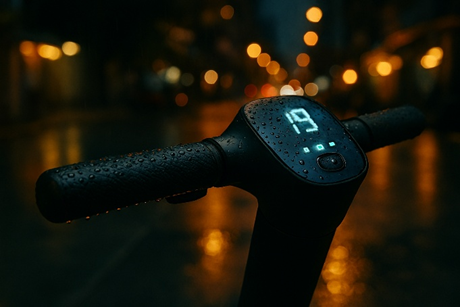
At GrabWheels, we could have used AI to simply optimise scooter placement based on ride patterns. Instead, we asked better questions: Could AI help us understand not just where riders are, but how they feel? Could it detect patterns in how someone struggles with a battery swap and offer a gentler tutorial? Could it learn what "safety" means in different neighbourhoods—not just statistically, but culturally?
This is the natural evolution of human-centred design. This principle guided real-world hardware decisions at GrabWheels. When designing the electric scooter's hazard light switch, the question wasn't just about ergonomic placement. It was, 'How does a rider find it instinctively during a sudden, stressful situation on a dark, rainy road?' We made it distinctly textured and within thumb's reach without looking, so the physical reassurance of locating it immediately could help counter a moment of panic. The 'sense' was the biomechanical reach; the 'sensibility' was designing for stress. Today, AI could learn to execute that same kind of thoughtful adaptation, not as a fixed feature, but as a responsive layer of empathy at scale.
The Designer's New Role: Compassionate Curator
This doesn't make designers obsolete. It makes us more essential than ever—as compassionate curators.
AI can generate a thousand chair designs in seconds, but it needs us to ask: Will this chair make someone feel cared for or institutionalised? AI can optimise a dashboard layout, but it needs us to ask: Does this information empower or overwhelm?
My most rewarding teaching moments weren't about teaching software skills, but about watching students learn to listen—not just to user data, but to the unspoken needs beneath it. That's our irreplaceable role: bringing human context to algorithmic intelligence.

A More Thoughtful Tomorrow
The promise of AI isn't smarter gadgets. It's more thoughtful relationships with our world.
Imagine:
o A voice assistant that doesn't just answer questions but senses frustration in your voice and responds with patience
o A mobility app that learns your personal definition of "accessible" and finds routes that match not just your physical needs, but your comfort
o Healthcare interfaces that adapt not only to declining vision, but to the anxiety that often accompanies it
This future requires us to build with both precision and poetry. To train our algorithms not just on data, but on human values. To create technology that doesn't just work well, but cares deeply.
After all, the most important interface we'll ever design isn't on a screen—it's the one between technology and the human heart. And that requires both Sense and Sensibility.

Article by Design Consultant & Researcher Lim Chee Koon. He has spent over two decades exploring where human-centred design meets emerging technology, from electric vehicles at Grab to ageing-friendly innovations. He believes the most exciting design problems live at the intersection of logic and empathy.


